Thesis Talk 2026
- Inicio
- Secretaría Virtual
- Ph.D. Research Skills Training
- Thesis Talk 2026

Winners of the Thesis Talk 2026 contest
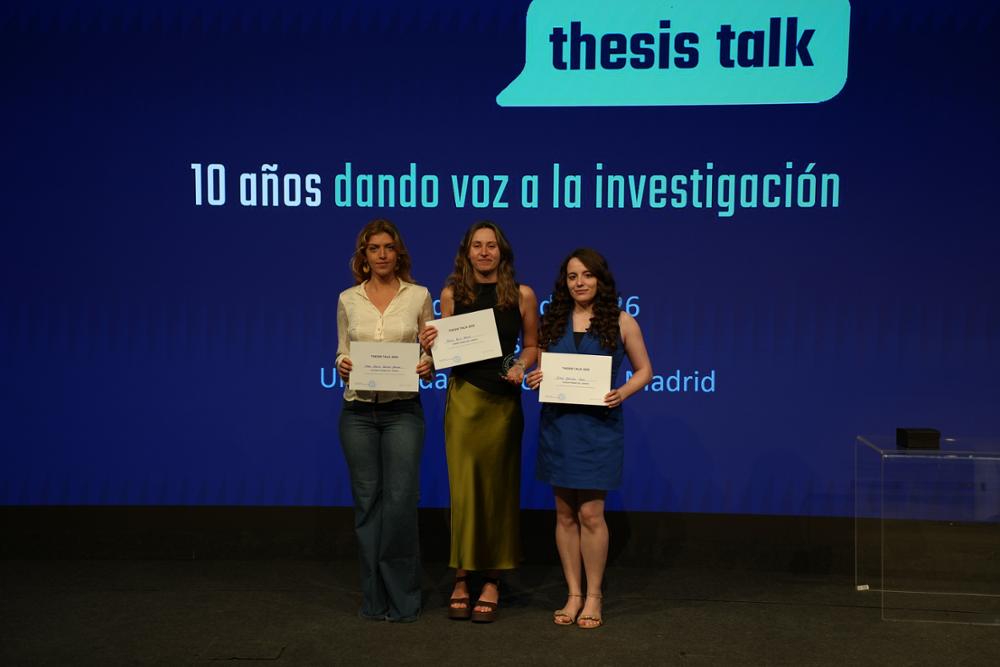
(from left to right, Isabel García Sánchez-Mayoral, second prize; Olena Velyt Vepryk, first prize, and Ester Martínez Sanzo, third prize of Thesis Talk 2026)
The final session of Thesis Talk 2026 took place on June 10th from 12:00 at Aula Magna in Getafe Campus (Building 8, Rectorado). Thesis Talk is the annual contest at Universidad Carlos III de Madrid where our PhD students present their thesis project in front of a non-specialized audience in less than 4 minutes.
The jury, Celeste Campo (Telematic Engineering), Michele Curnis (Humanities), Antonio Descalzo (Public Law), César Huete (Thermal and FLuids Engineering) and Iria Medraño (Neuroscience and Health Sciences) awarded with 900, 600 and 300 euros, respectively, the three highest-ranked presentations, which were:
First Prize: Olena Velyt Vepryk (PhD in Materials Science and Engineering) - "Bacterias: acceso denegado"
Second Prize: Isabel García Sánchez-Mayoral (PhD in Advanced Studies in Human Rights) - "Ya eres mayor"
Third Prize: Ester Martínez Sanzo (PhD in Media Research) - "El reto de la inteligencia artificial a través de los medios"
Congratulations on the good work!
The final was broadcast live via YouTube streaming and can be watched in its entirety here: Thesis Talk 2026 Final
Photo Gallery of the Thesis Talk 2026 Final on Flickr
-----------------------------------------------------------------------------------------------------------------------------------------------------
These were the rest of presentations shortlisted for the final:
Alba Martínez Serrano (PhD in Signal Processing and Communications Engineering) - "Hablar sin voz"
Ana Ortuño Candela (PhD in Media Research) - "Ojos que ven, corazón que siente"
(Excused absence) Carmen Díaz de Mera (PhD in Computer Science and Technology) - "Terapia con un robot hecho para ti"
Claudio Morchón (PhD in Statistics for Data Science) - "El latido de Madrid"
Gema Salinero (PhD in Electrical Engineering, Electronics and Automation) - "Detección y localización de arcos en serie en sistemas aeronáuticos"
(Excused absence) Henry Summers (PhD in Materials Science and Engineering) - "Meta-high-entropy lattice architectures for enhanced strength and damage tolerance"
J. Luigi M. Kunz Saponaro (PhD in Humanities) - "Standing in Front of Walls"
(Excused absence) Javier Borau Bernad (PhD in Electrical Engineering, Electronics and Automation) - "Enseñando a ver a las cámaras de tráfico"
(Excused absence) Manuel Suárez Román (PhD in Computer Science and Technology) - "Iluminando las sombras de la Ciberinteligencia"
Mario Resino Solis (PhD in Electrical Engineering, Electronics and Automation) - "Anticipar para salvar vidas: predicción de movimiento en el tráfico"
Máximo Rodríguez (PhD in Computer Science and Technology) - "Clasificación y Segmentación de Osteosarcoma en Tomografía Computarizada"
Mohammad MH. Rahmani (PhD in Computer Science and Technology) - "EchoLimb: a Body Transformation Experience"
Nikolaos Ziakos (PhD in Aerospace Engineering) - "How to speedrun aircraft design"
Paloma González Beluche (PhD in Law) - "Daños derivados de la innovación: ¿quién indemniza a la víctima?"
Rafael Ramos Uña (PhD in Electrical Engineering, Electronics and Automation) - "Nanofotónica: expertos en luz y cosas pequeñas"
Teresa Cantero García-Moncó (PhD in Advanced Studies in Human Rights) - "Artificial Intelligence and Civilian Protection in Armed Conflict "
------------------------------------------------------------------------------------------------------------------------------------------
Below you may find all the presentations that participated in the contest, sorted by research area:
Ciencias Sociales
PhD in Economics
Serkan Kocabas - The Hidden Path of Carbon Costs
PhD in Economic History
Benjamin Reinertz - Semenital Analysis and the Spanish Civil War
Law
PhD in Law
Jorge Alejandro Molina Méndez - La indemnización por daño moral ante la violación de la dignidad humana
PhD in Advanced Studies in Human Rights
Rodrigo Merayo - La pobreza como injusticia global: filosofía política y derechos humanos
Arturo Romero Muñoz - Medir derechos para mejorar vidas
Comunicación, Documentación y Humanidades
PhD in Library Science: Archives and Libraries in the Digital Environment
Susan Margaret Correa Núñez - Metodología para el diseño e implementación del Sistema de gestión documental
Luis Alejandro Cardozo Londoño - OPEN BUILDING DATA: Ciencias Abierta para el sector de la construcción
PhD in Media Research
Camila Satt Castillo - El cortometraje como experiencia de creación en realizadoras españolas del período 1975-1985
Raúl Jambrina Rojo - El niño-flâneur y la niña-flâneuse: la infancia en la ciudad y sus espacios a través la ficción televisiva de animación desde los 2000
Rocío Sánchez del Vas - Bulos sin pasaporte: El fact-checking europeo frente a la desinformación transnacional
Sergio García Maeso - Historia del cine-rock español (1960-2024)
Ingeniería y Ciencias
PhD in Materials Science and Engineering
Víctor Ramos Sánchez - Salvar el Planeta Azul
Paula Alejandra Chonillo Vera - Metales al límite: adelantando el paso del tiempo
Angela García Grech - Holistic Co-Design of Scaffolds via Automated Experimentation and Machine Learning: Composition, 3D Printing, and Degradation of Multimaterial Architectures
Deepa Davison - When disorder cooperates to fuel the future
Archana Ravi - Tracking defects as they form: physical simulation of 3D printing
Ángel Biedma Trillo - Dándole la vuelta a la tortilla: Rediseñando los materiales para herramientas de corte
PhD in Biomedical Science and Technology
Irene Mancebo Laguna - Un gemelo digital para cuidar cada corazón
Long Lin - IA para el estudio de señales en arritmias cardíacas
PhD in Computer Science and technology
Carmen Díaz de Mera - Terapia con un robot hecho para ti
Manuel Suárez Román - Iluminando las sombras de la Ciberinteligencia
Victor Alfredo Apaza Mamani - El enjambre que salva vidas
Dario Muñoz Muñoz - Sistemas que se adaptan y resisten: el futuro del almacenamiento en HPC
Yuda Li - Sistemas energéticos más inteligentes y flexibles con aprendizaje automático y optimización
Enrique Mateos Melero - Entrenamiento eficiente en aprendizaje por refuerzo offline
Roberto Cuervo Rosillo - Utilizando la Inteligencia Artificial para Acelerar el Modelado de Simulaciones de Dispositivos Laborales Comunes en Realidad Mixta
PhD in Electrical Engineering, Electronics and Automation
Javier Barco Álvarez - Energía a través de la fibra óptica: del concepto a la realidad
David Hernández Guerrero - Cuando lo invisible se hace visible
Álvaro Pérez Borondo - Avanzando hacia la sostenibilidad con el almacenamiento en baterías
Javier Borau Bernad - Enseñando a ver a las cámaras de tráfico
Daniel San Laureano Igartuburu - El ruido eléctrico: un problema invisible
Vafali Soltanmuradov - End-to-End Autonomous Parking: From Simulation to Real-World Deployment
Taskin Aman Khan - Quantification of Residual Mineral Oil in Retrofilled Transformers Using ATR-FTIR Spectroscopy and Physicochemical Characterization
Fernando Quevedo Vallejo - Fast Marching with Narrowband preservation
PhD in Mechanical Engineering and Industrial Organization
Elizabeth Afua Boamah - Waste is the new fuel
PhD in Plasma Physics and Nuclear Fusion
Daniel Medina Roque - La importancia de la higiene en los plasmas de fusión
PhD in Plasma Physics and Nuclear Fusion
Laura Rodrigo Muñoz - Escuchar para detectar : la voz como ventana al párkinson
Nashat Osama Elazab - Capsule Medical Implants Without Batteries
Chi Cui - When Data Lies
Claudia Montero Ramírez - Inteligencia Artificial contra la violencia de género
THESIS TALK 2026
Thesis Talk 2026 - Terms and conditions of the contest
Thesis Talk 2026 - Call (English version)
Through Thesis Talk, our Ph.D. Candidates are welcome to present their research projects before a non-specialist audience in just 4 minutes, focusing on the what , how and why of their research. A single static slide is permitted to enhance your presentation. Participants can choose the language of their presentation (English or Spanish).
THESIS TALK is inspired by Three Minute Thesis (3MT), originally created by the University of Queensland (Australia) in 2008, and replicated by more than 200 universities around the globe. Through this initiative, the Doctoral School highlights the importance of the research projects carried out by our PhD students and encourages their dissemination through a format and language adapted to the non-specialized audience.
Thesis Talk 2026 is open to all our students enrolled in a Ph.D. program during the 2025/2026 academic year, including those who have participated in previous editions.
This year's edition will consist of two stages: an online pre-selection and an on-site final event.
If you are interested in submitting your cadidacy, you must complete the apllication in two steps:
- Filling and submitting the application form before March 17th 2026 (23:59 CET)
You need to attach this autorization of participation form, signed by your thesis director
- Send your presentation video + static slide to escueladoctorado@uc3m.es (may be as file attachemnts or links to clud storage) before May 6th 2026 (23:59 CET)
Thesis Talk ins a 2-credit activity of our research skills training program (transversal trainin)
Reigstration is free
Cómo concursar
Las y los participantes deberán enviar su presentación en formato vídeo, y deberán tener en cuenta las siguientes consideraciones:
- Idioma: castellano o inglés (nivel mínimo exigido: C1 o equivalente)
- Límite de tiempo: 4 minutos. Las presentaciones que sobrepasen dicha extensión no serán admitidas.
- Se puede elegir libremente el título de la presentación. Puede ser diferente al título de la tesis doctoral.
- Se puede aportar una diapositiva/imagen fija (PowerPoint o similar). La diapositiva no puede contener ningún elemento dinámico (animaciones, transiciones, elementos que aparezcan más tarde…). Tampoco puede contener el nombre del participante, el título de la investigación ni afiliación académica o profesional.
- La diapositiva no puede insertarse en el vídeo; se debe enviar por separado para que sea editada posteriormente.
- No se puede utilizar contenido multimedia adicional (p. ej. archivos de audio o vídeo)
- No se permiten accesorios de apoyo (disfraces, instrumentos musicales, equipo de laboratorio)
- La presentación debe ser hablada (no se permiten poemas, canciones o raps); se pueden citar otros autores si las citas son relevantes para el tema de la tesis.
Características técnicas:
- La grabación puede realizarse con cualquier dispositivo (móvil, webcam, cámara…)
- Orientación: Horizontal
- Formato: mp4
- El vídeo no puede mostrar cortes o haber seguido procesos de edición; excepto por cortes al principio y al final para eliminar detalles menores (encender y apagar la cámara, etc).
Recomendaciones:
- Resolución: 1920 x 1080
- Plano fijo medio centrado
- El fondo debe ser neutro o difuminado para centrar la atención en la presentación.
- Se recomienda grabar el vídeo en una localización interior, silenciosa, con luz natural, evitando iluminación artificial o iluminación posterior.
Recomendaciones de distribución de tiempos:
- 15-30 segundos: alcance y propósito del proyecto de investigación.
- 120-150 segundos: contribución personal del/la estudiante, metodología y resultados.
- 30-60 segundos: significado de la investigación y resultados clave de la misma.
Preparation
Participants can prepare their presentation in two ways:
1- Preparatory workshops of the Doctoral School (optional)
Workshop in Spanish (6 hours).
--- Teacher: Mercedes Cavanillas
--- Wednesday 8 and Tuesday 14 April from 10:30h a 13:30h, online, 12 seats
This workshop is a reduced version of the workshop “Efficient presentations” from our catalog of research skills training (transversal training).
Workshop in English (6 hours). Minimum English level required: C1 or equivalent.
--- Teacher: Trisha Ballsrud
--- Monday 13 and Tuesday 14 April from 09:30h a 12:30h , on-site (Leganés campus), 8 seats
Free registration. To sign up for these workshops:
- Applicants must check this option on the application form.
- The language of the workshop must be the same as the presentation.
- Places are limited and allocated on a first-come, first-served basis.
- Commitment to attend both sessions is required.
2- Self-preparation. The following material can be useful:
Thesis Talk (previous editions): 2025 | 2024 | 2023 | 2022 | 2021 | 2019 | 2018 | 2017 | 2016
3MT Presentations | The University of Queensland (Australia)
3MT Presentations | Aarhus University (Dinamarca)
How to win the 3MT. Original from thesiswhisperer.com
Stages
Pre-selection (estimated for second half of May)
Once the registration has been completed, videos will be shared only with the members of the Jury designated by the Dean of the Doctoral School. The Jury will evaluate the videos and select a shortlist of 15* participants to qualify for the final. The videos will be publicly available then.
*Number is subject to change according to the Jury's criteria.
Final: June 10th 2026 at 12:00pm - Aula Magna of Getafe campus.
Finalists will deliver their presentation in person. A jury of experts will assess the presentations and choose the three best according to the evaluation criteria established in these contest rules. The jury's decision will be announced at the end of the final.
ON-SITE FINAL EVENT: Please keep in mind that if your presentation is selected for the Final, it is an event that requires your presence at the University on the indicated date. You will not be able to participate remotely.
Evaluation criteria
The presentation must:
- Focus on research work and personal contribution.
- Provide understanding of background and significance of research.
- Describe methodology and key results of research.
- Follow a clear, logical sequence.
The presenter must:
- Capture the attention of the audience: presence, vocal range, pace, confident delivery...
- Use an appropriate language for a non-specialist audience, without trivializing the research.
The slide must:
- Enhance the content of the presentation, not replace it.
Prizes
The three best presentations will receive prizes of €900, €600 and €300.
Prizes subject to current tax legislation.
Further information
Please check the information on the official call for the most comprehensive and complete information.
We also recommend checking our Thesis Talk - FAQ
For further questions, please contact escueladoctorado@uc3m.es